
AI, authorship and the erosion of originality: What brands need to understand now
AI has quietly moved from experiment to everyday tool: what started as curiosity is now embedded in how content is produced, scaled and distributed. For brands, this is not just a technical move. It is a creative and legal one too.
The core issue is simple. AI systems are trained on existing work, often without clear attribution or consent. They generate outputs that feel new, but are built on what already exists. That raises a question the industry has never had to answer at this scale: who actually owns the result?
This tension has always existed
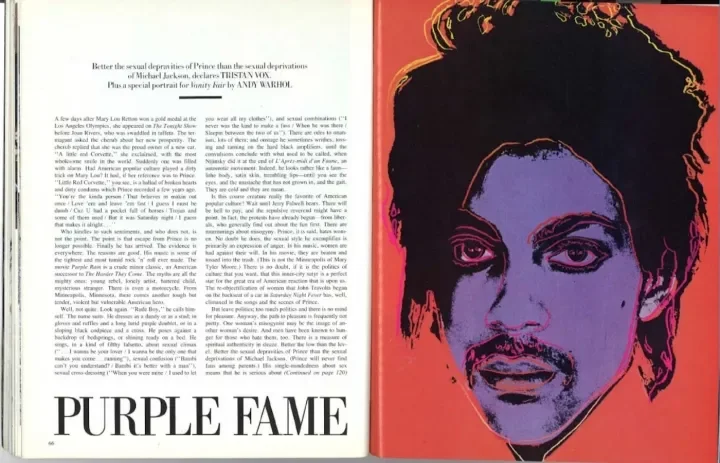
Andy Warhol’s Prince illustration based on the Lynn Goldsmith photograph as it appeared in Vanity Fair, here reproduced in court documents.
Creative industries have always borrowed from themselves. Trends, references and visual languages move in cycles; what changes is how fast and how visibly that happens.
The idea that creators should own their work dates back to the Statute of Anne, recognised as the world’s first modern copyright law, which shifted control from publishers to authors. It set a precedent that still shapes modern copyright thinking.
Later, cases like Folsom v. Marsh introduced the idea that some level of reuse is acceptable (now known as “Fair use” and a very important topic in the era of content creation). Not everything is infringement. Context matters. Intent matters. Impact matters.
Even in contemporary art, the line has never been clear. The legal dispute around Orange Prince showed how difficult it is to define when something becomes “new enough”.
In other words, this is not a new problem. AI just makes it harder to ignore.

What AI changes for brands
The difference with AI is scale and distance.
A designer might reference five or ten sources when creating a concept. An AI model references millions. The output may not copy a single piece, but it is still derived from a collective body of work.
This creates a disconnect. The final asset looks clean and resolved, but the origin is blurred.
For brands, that matters more than it might seem. Strong brands rely on authorship, they are built on a clear point of view, not just a visual outcome. When that point of view becomes diluted, so does differentiation.
Whatever it is, the way you tell your story online can make all the difference.
The legal system is still catching up
Recent lawsuits involving Getty Images and Stability AI, as well as claims brought against OpenAI and Microsoft, show how unsettled the situation is.
At the centre of these cases is one key concept: fair use.
Traditionally, fair use depends on how much of a work is used and whether it affects the original’s value. With AI, that framework becomes harder to apply. Models are trained on large datasets, not individual works. The output is often transformed, but not entirely disconnected.
There is no clear threshold yet. And that uncertainty is likely to remain for some time.
The bigger risk is creative sameness
From a branding perspective, the more immediate concern is not legal. It is creative.
AI outputs often converge toward a certain aesthetic. Clean, balanced, visually pleasing, but familiar. When multiple brands use the same tools in similar ways, the result is a flattening of visual identity.
We are already seeing it. Campaigns that look interchangeable. Product imagery that feels generic. Tone of voice that lacks nuance.
For premium and luxury brands, this is particularly problematic. Perceived value is tied to distinctiveness. If everything starts to feel the same, that value erodes.
Rethinking value and ownership
AI also shifts how creative work is priced and protected.
If a single campaign can be used to generate hundreds of variations through AI, then the original idea becomes more valuable, not less. It is the source of everything that follows.
This is starting to influence contracts, licensing and usage rights. There is a growing argument that brands should pay not just for the output, but for the long-term value of the underlying IP.
It is an early shift, but an important one.
How we approach it at UNYQ
We see AI as a tool for efficiency, not authorship. It can support production, testing and iteration. It can speed up workflows. But it should not replace the thinking that defines a brand.
For our clients, that means:
Using AI to scale assets, not to define identity
Keeping core creative direction human-led
Protecting original work as a strategic asset
Being intentional about where automation is introduced
The goal is not to avoid AI, but to avoid becoming indistinguishable.